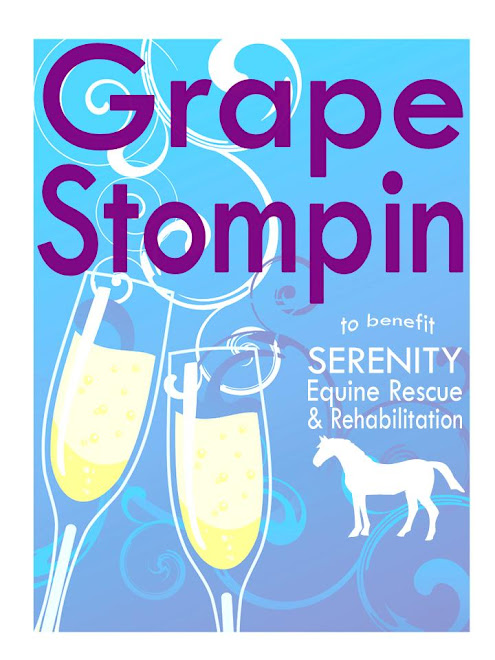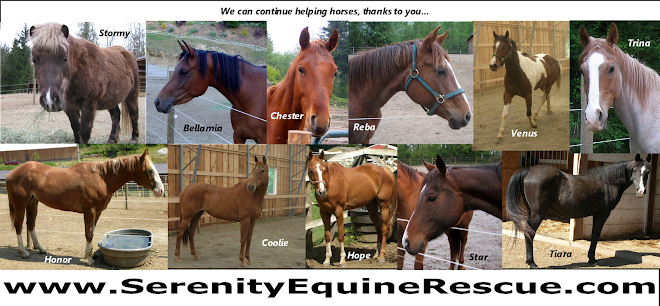
The amazing, sweet folks at V2 Farm in Enumclaw are hosting a fundraiser for us- isn't that great? Several of our Board Members and volunteers plan to come, won't you join us?
"Grape Stompin' for Serenity Equine Rescue" on Saturday, September 12th from 1- 5 pm.
Your $35 ticket includes entry to an event that includes wine tasting, live band, a terrific silent auction and a grape stomping competition (teams of 3, no extra charge to stomp!) with all proceeds going to our rescue.
We could really use the funds, and you could really use the FUN. You can hang out with us, we'll be there telling stories and hanging out with everyone. You don't even have to like wine, so long as you like good company and good times you'll be glad you came.
To purchase your tickets or for more information, e-mail us at info@serenityequinerescue.com . You can pay by cash, Visa/MasterCard, or check. We are currently accepting donations for the silent auction, if you'd like to contribute.
Monday, August 10, 2009

Tuesday, July 14, 2009
Microsoft Intern Day of Caring
 What a day- Friday was amazing, thanks to the Interns from Microsoft.
Over 40 Microsoft interns (and about a dozen full time MS employees) came out to work for the day at the rescue. We estimated that over 160 hours of work were done that day, saving us thousands of dollars and improving our farm considerably.
Here's what we got done:
- We dug a ditch from our barn to the drainage area, which will substantially reduce flooding in fall and winter. Many rescue horses come in with hoof disease and injuries, both of which are exasperated by mud so flooding is important for convenience and health.
- Our new ditch was filled with rocks picked from pastures – removing rocks is important because it protects the animals from stone bruises and injures and also saved us from having to buy gravel to fill our new ditch. Rocks in our ditches keep the water flowing in the right direction without letting the ditch collapse.
- We put in hogsfuel (an outdoor bedding made from cut down trees- eco friendly) so that we won’t have to put all the horses into indoor stalls at night. The hogsfuel gives them a comfortable place to rest and will reduce the amount we have to spend on shavings. Because of the recent closure of several saw mills, shaving costs are high so this is an important measure.
- We also installed posts for our sign in the driveway, a chore that we've wanted to get done for a while.
- One group groomed and photographed horses so we can better promote them and find them homes. It is also excellent practice for our rescues to be handled by a variety of people, so there were multiple benefits.
- We completed the re bar/stabilizing of our steps which gives us a safe place to get up and down our hill.
All of these projects were really needed but could not have happened without this Day of Caring.
As a nonprofit organization we rely on donations and grants for our funding and our suffering economy has affected us (along with other rescues) so we strive to reduce costs any way we can- on Friday we made some tremendous strides in this area, thanks to you all.
A special thanks to the committee that coordinated this event and our Serenity Volunteers who came out to spend the day helping lead these projects, and also those who helped us get items donated.
More photos from Friday are at: http://serenityequine.shutterfly.com/
Thursday, July 2, 2009
Twittering Serenity...
We're on Twitter now so you can follow Serenity and hear what we're up to a couple times a week (we plan to tweet about 3 times a week hopefully).
How to follow us:
From Wickipedia:
Think of it as a quick and short way to stay up to date by email or text message with someone or a group. You might get a message that tells you we've had a horse adopted, or you might even get one that says we're looking for an item (like right now we need pointed shovels for an upcoming event!!)
Here is a great page of info from Twitter: http://help.twitter.com/portal
If you have questions, email our webmaster Cowgirly at webmaster@serenityequinerescue.com. We look forward to tweeting with you (we're still learning the lingo!!). If you send me an email with the subject line 'twitter subscribe' our webmaster will send you an invite to subscribe to make it easy on you!
How to follow us:
- Either log on to www.twitter.com and request to follow serenityequine
- you can text the message: "follow serenityequine" to the number 40404 on your cell phone
be sure to read this page on twitter to better understand how it works and of course make sure you've got a good text plan if you use your cell phone to follow us.
Here is more information on twitter, for those of you new to it:From Wickipedia:
Twitter is a free social networking
and micro-blogging service
that enables its users to send and read each others' updates, known as tweets.
Tweets are text-based posts of up to 140
characters, displayed on the author's profile page and delivered to other users
- known as followers - who have subscribed to them. Senders can restrict
delivery to those in their circle of friends or, by default, allow open access.
Users can send and receive tweets via the Twitter website, Short Message Service (SMS) or
external applications. The service is free over the Internet, but using SMS may
incur phone service provider fees.
Think of it as a quick and short way to stay up to date by email or text message with someone or a group. You might get a message that tells you we've had a horse adopted, or you might even get one that says we're looking for an item (like right now we need pointed shovels for an upcoming event!!)
Here is a great page of info from Twitter: http://help.twitter.com/portal
If you have questions, email our webmaster Cowgirly at webmaster@serenityequinerescue.com. We look forward to tweeting with you (we're still learning the lingo!!). If you send me an email with the subject line 'twitter subscribe' our webmaster will send you an invite to subscribe to make it easy on you!
Wednesday, June 24, 2009
In Memory of Chester
 On June 24, our little 3 year old Chester was humanely euthanized. Chester was enjoying a lush summer pasture at a foster home on a large pasture when he took an unfortunate misstep and fractured a bone. Our veterinarian, after treating Chester for 3 weeks, took another x-ray yesterday and determined that his prognosis for recovery was unlikely , and that Chester was in extreme pain . The fracture had completely separated and a large piece of bone was now floating in his hoof. The Coffin bone was also infected.
Chester came to Serenity February of 2008 as one of the horses rescued from PEC. He was a malnourished baby with parasites, lice, overgrown and cracked hooves and in need of a lot of health care, love and attention. After several months Chester started to grow and fill out. He became healthy and trusting. His beautiful coat, shining like a new copper penny in the sun, and his kind loving temperament always drew people to him. We at Serenity adored him and he will be sorely missed.
The following articles are shared to help our readers better understand the complications of fracture in horse’s legs. Though we will miss Chester, we are proud of the fact that the life he lead at Serenity was one of healing and growth and love. If you would like to contribute to our veterinary fund to help offset the cost of Chester’s treatment, please send your checks to Serenity and note "Chester" in the memo line make checks payable to Mt. Rainier Equine.
By Daniel Engber
Barbaro's veterinarians say the champion racehorse has a 50 percent chance of survival after breaking his leg at the start of the Preakness. He may not recover even after a successful five-hour surgery on Sunday, during which he had almost two dozen screws implanted to stabilize his bones. Why is a broken leg so dangerous for a horse?
There's a high risk of infection, and the horse may not sit still long enough for the bone to heal. Infections are most likely when the animal suffers a compound fracture, in which the bones tear through the skin of the leg. In this case, dirt from the track will grind into and contaminate the wound. To make matters worse, there isn't much blood circulation in the lower part of a horse's leg. (There's very little muscle, either.) A nasty break below the knee could easily destroy these fragile vessels and deprive the animal of its full immune response at the site of the injury.
Barbaro was lucky enough (or smart enough) to pull up after breaking his leg. If he'd kept running—as some horses do—he might have driven sharp bits of bone into his soft tissue and torn open the skin of his leg. Though his skin remained intact, he still faces the possibility of infection; any soft-tissue damage at all can cut off blood flow and create a safe haven for bacteria.
It's not easy to treat a horse with antibiotics, either. Since the animals are so big, you have to pump in lots of drugs to get the necessary effect. But if you use too many antibiotics, you'll destroy the natural flora of its intestinal tract, which can lead to life-threatening, infectious diarrhea. You also have to worry about how the antibiotics will interact with large doses of painkillers, which can themselves cause ulcers.
If the horse manages to avoid early infection, he might not make it through the recovery. First, he must wake up from anesthesia without reinjuring himself. Doctors revived Barbaro by means of "water recovery." That means they suspended him in a warm swimming pool in a quiet room and then kept him there for as long as possible. Not all horses are willing to sit around in a sling, and the antsy ones can thrash about and break their limbs all over again. (In 1975, the filly Ruffian managed to break a second, healthy leg in the process.)
If Barbaro starts favoring his wounded leg post-surgery, he may overload his other legs, causing a condition known as "laminitis." If that happens, the hooves on the other legs will start to separate from the bone, and his weight will be driven into the soft flesh of the feet. He may also develop life-threatening constipation as a side effect of the anesthetic.
Doctors will often put down a horse that develops a nasty infection, reinjures its broken leg, or develops laminitis in its other hooves. (A horse that's unable to stand will develop nasty sores and can be expected to die a slow and painful death.) A few horses have had broken legs amputated and replaced with metal, but the equine prostheses don't have a great track record.
Got a question about today's news? Ask the Explainer.
Explainer thanks Rick Arthur of the American Association of Equine Practitioners and Carl Kirker-Head of the Cummings School of Veterinary Medicine at Tufts University.
This next article is from the Ultimate Horse Site
Why are horses killed if they break a leg?Racehorses break legs and are euthanized; why are they put down?
By Annamaria Tadlock
Horses may not be "shot" when they break a leg, like in old westerns, but today their fate is often still the same: A broken leg is still usually a death sentence for a horse.
In the wild, a horse with a broken leg becomes dinner for a predator pretty quick. But when someone's pet-- or a champion racehorse-- breaks a leg, owners will what they can to try and save them. The reality is that most horses with a bad break won't recover-- due to costs, the time involved in healing, the horse's anatomy and behavior, and other issues.
- Success depends on the severity of the injuryWhen breaks are minor, such as small fractures,or when they are in young or small horses, the chances for recovery are higher. A foal with a broken leg may have a much better chance at recovery because they are still young and growing, and their bodies are lighter.Incomplete fractures are when a bone under stress cracks but doesn't break, and those tend to be much easier to heal. This type of injury is more common in performance horses and usually heals, leaving the horse able to perform and function normally.
Complete fractures mean the bone is completely broken through. This generally occurs in a sudden traumatic incident, such as when a racehorse breaks down or trips, or horses kick each other, causing the bone to shatter and break into pieces. Bones that come through the skin may be full of dirt or grass and greatly contaminated.
This type is much more difficult to heal for many reasons and generally is fatal to a horse. In cases of bad breaks, an animal is quickly humanely euthanized because there simply are no treatment options (such as Eight Belles, who shattered two legs at the fetlock and cannon bone).
- Horse legs aren't designed to heal--All horses are big, heavy animals on small legs and feet, and each foot has to support roughly 250 pounds. When one breaks, it is difficult for the other legs to handle that weight. Even after a successful surgery to repair a damaged leg, the other legs may develop laminitis or abscesses because they have to carry extra weight on their other legs (this is what ultimately killed Barbaro, 8 months after successful surgery). There is no muscle below the knee or hock joint, meaning those leg injuries do not receive the same amount of support or blood flow.This can lead to complications in healing. The large bones of a horse also take a long time to heal. Fractures that break the skin often contact dirt, grass, or manure, making the risk of infection very high.
- Horses don't like to be still --Horses are active creatures. They are designed to run from predators (or today, on the racetrack) and love to move about and play. Keeping a horse from re injuring itself is a big problem in recovery. They can step on themselves, get excited and try to move around, or simply get bored of being in a stall and try to get out.
Many horses simply won't comply with treatment procedures. Ruffian's surgery to repair her broken leg was successful, but she continued to thrash and ended up injuring herself badly and had to be euthanized. Nureyev broke his leg while free in his pasture when he was 10 years old, and he was saved because he tolerated slings and stall rest so well.
When the ex-racehorse Alydar broke his leg at the age of 15, he underwent surgery, but two days later he broke the leg again moving about on it and had to be euthanized. - Can't they use slings? Slings are used to help bear weight, but they can't be a long-term option because they do cause other problems, such as bed sores and discomfort to the horse. Some weight is needed to be on the injured leg to ensure it recovers the strength needed to support the horse. The other legs can develop laminitis or abscesses, and the horse may object to being in a sling and struggle, injuring itself further.
- Pain Management--Having a broken bone is painful, and drugs are administered to control pain-- but if you give too little, the animal suffers, and if you give too much, they feel fine and want to gallop around. When horses are on pain medication they may re injure themselves moving around.
- Huge Expenses & Few Vets--Treatment options are also very expensive; the average horse owner cannot afford the thousands of dollars it can take to recover, or provide the care needed. When you hear about horses being rehabilitated, it is usually an expensive racehorse, not an average racehorse or a riding horse. There are success stories, but they are the exception.When Barbaro fractured his hind leg (in more than 20 places) his owners went to great expense to attempt to save him. Surgically implanted steel plates, specially designed horse swimming pools, constant monitoring and pain management were all a part of his recovery attempt. They had the resources to provide the best care available. But they kept fighting with abscesses and painful laminitis that developed and he was euthanized 8 months after the initial injury.Even if an owner has the money to try to rehabilitate a horse with a broken leg, which most do not, there are few vets and facilities that can handle that situation. While racehorses may have the benefit of being surrounded by vets and other professionals, few horse owners live anywhere near equine vets or facilities that can handle injuries.
- Humane Euthanasia --The amount of pain and time that the horse has to be locked up in a small space to recover from a bad break is considered by many to be inhumane. If the horse is kept off the leg, the injury may heal, but the other legs can develop complications, as was the case with Barbaro. Often the only humane option is to euthanize a horse when they break a leg. Sometimes, it is the only choice, when a break is so severe or multiple legs are broken ( such as the case with Eight Belles).
Here are our before and after photos of our Chester...
Chester came to us so malnurished that his growth was inhibited, he had worms and lice (left) and was in terrible shape.

He healed inside and out at Serenity and became a sweet gelding who was healthy and happy, and that is how we will remember him. Rest in peace, our sweet friend.

Subscribe to:
Posts (Atom)

 Posts